India’s Forex Reserves Cross USD 700 Billion Mark: A Sign of Macro Stability

India’s Forex Reserves Cross USD 700 Billion Mark: A Sign of Macro Stability

India’s foreign exchange reserves continued their upward trajectory, rising by USD 4.496 billion to reach USD 702.28 billion for the week ending October 17, 2025, as per the latest data released by the Reserve Bank of India (RBI).

Crossing the USD 700 billion milestone underscores India’s economic resilience and its ability to withstand global uncertainties, currency volatility, and trade fluctuations.

Growth Breakdown: What’s Driving the Surge

The recent increase in reserves is largely attributed to changes in the composition of India’s foreign assets and gold holdings.
Key data highlights include:

  • Total Forex Reserves: USD 702.28 billion (up by USD 4.496 billion from the previous week)

  • Foreign Currency Assets (FCA): Slight decline of USD 1.692 billion to USD 570.41 billion

  • Gold Reserves: Significant rise of USD 6.18 billion, reflecting stronger valuation and holdings

  • Overall Increase: Driven by favourable currency revaluation and higher gold prices in global markets

This marks the second consecutive week of reserve expansion, indicating a steady improvement in India’s external balance position.

Implications for India’s Economy

The rise in forex reserves holds major implications for macroeconomic stability and investor confidence:

  • Enhanced Currency Support: A larger reserve base provides the RBI more flexibility to manage rupee volatility during periods of global uncertainty.

  • Improved Import Cover: India’s reserves now provide over ten months of import coverage, strengthening its external resilience.

  • Boost to Market Sentiment: The milestone enhances global investor confidence in India’s fiscal and external health, making it an attractive investment destination.

What It Means for Investors and Wealth Managers

For mutual fund distributors, financial advisors, and wealth managers, India’s growing reserve base is a strong macro signal supporting long-term portfolio stability.

  • Market Confidence: The surge in reserves reinforces India’s image as a secure investment environment.

  • Equity Outlook: Stable reserves support currency management, which helps sustain corporate earnings, particularly in export-heavy sectors.

  • Client Strategy: This development can be positioned as part of the broader India-growth narrative, encouraging clients to maintain exposure to India-focused equity and hybrid funds.

Risks and Global Context

While the reserves provide a strong buffer, several factors could still influence future movements:

  • Global commodity and oil price volatility

  • Shifts in foreign portfolio investment inflows and outflows

  • Policy decisions by global central banks, especially the U.S. Federal Reserve

Wealth advisors should remain watchful of these trends when discussing asset allocation or currency exposure with clients.

Source: MoneyControl
Budget 2026 to Integrate Five-Year Sectoral Action Plans to Realise “Viksit Bharat @ 2047”

Budget 2026 to Integrate Five-Year Sectoral Action Plans to Realise “Viksit Bharat @ 2047”

The Union Budget 2026 is expected to move beyond being a one-year fiscal statement. It will likely become a strategic roadmap aligning annual spending with medium-term development goals across priority sectors – all tied to the government’s long-term vision of Viksit Bharat @ 2047.

A New Approach to Budget Planning

The government is working to integrate five-year sectoral action plans into the upcoming Budget framework. These plans will help ministries set clear targets, streamline resource allocation, and maintain continuity across fiscal years.

Key sectors identified for this integration include:

  • Infrastructure

  • Petroleum & Natural Gas

  • Telecom

  • Science & Technology

  • Pharmaceuticals

High-level sessions have already started. On 16 October, meetings led by NITI Aayog and the Ministry of Finance discussed infrastructure planning, followed by sessions on petroleum, natural gas, and telecom (17 October), science & technology (23 October), and pharmaceuticals (24 October).

The purpose is clear — to bring alignment between project priorities, policy execution, and funding under a unified governance framework that enhances accountability and effectiveness.

What This Means for Budget 2026

With this approach, the Union Budget is set to evolve into a strategic financing tool that not only handles yearly allocations but also tracks each ministry’s progress toward medium-term objectives.

  • Budget allocations will be guided by five-year blueprints for every major sector.

  • Ministries will operate with defined performance indicators and measurable deliverables for 2025-30.

  • Policy decisions and capital expenditure will gain a longer-term focus, ensuring continuity beyond political or fiscal cycles.

This marks a shift from short-term budgeting to outcome-based financial planning, bringing India closer to its 2047 development vision.

Implications for Investors and Businesses

For businesses, policymakers, and market participants, this change signals greater predictability and stability in economic policy.

  • Corporate sectors can plan long-term investments with more clarity on government priorities.

  • Institutional and retail investors may benefit from sustained growth trends in sectors backed by multi-year plans.

  • Wealth managers and mutual fund distributors (including Prudent Asset India) can identify emerging investment opportunities tied to government-supported sectors such as infrastructure, energy transition, and digital technology.

By integrating five-year plans into the Budget, the government aims to create a policy ecosystem that supports sustained capital formation, innovation, and inclusive growth.

Strategic Outlook

Sectors like infrastructure, petroleum & natural gas, telecom, science & technology, and pharmaceuticals are poised to receive enhanced budgetary focus and policy reform push.

This medium-term planning approach could:

  • Boost investment in manufacturing and logistics.

  • Accelerate digital and telecom expansion.

  • Strengthen energy diversification and transition goals.

  • Encourage research and innovation within pharmaceuticals and technology.

Investors aligning their portfolios early with these sectors may enjoy a strategic advantage as capital flow and policy support strengthen in the coming years.

Source: MoneyControl

SEBI Bars Mutual Funds From Participating in Pre-IPO Placements

SEBI Bars Mutual Funds From Participating in Pre-IPO Placements

The Securities and Exchange Board of India (SEBI) has announced a new regulation that prohibits mutual fund schemes from investing in pre-IPO placements of equity shares and related instruments.
This restriction applies to placements made before the opening of the anchor investor portion or the public issue of an Initial Public Offering (IPO).

Understanding SEBI’s Directive

The new directive is rooted in Clause 11 of the Seventh Schedule of the SEBI (Mutual Funds) Regulations, 1996, which states that:

  • Mutual fund investments in equity or equity-related instruments must be in securities that are listed or to be listed.

  • Investing in pre-IPO placements violates this principle since these shares are not yet listed at the time of purchase.

SEBI clarified that if a mutual fund invests in pre-IPO placements and the IPO listing is delayed or cancelled, the scheme could end up holding unlisted shares, thereby breaching the mutual fund investment regulations.

As a result, mutual funds may now invest only in:

  • The anchor investor portion of an IPO, or

  • The public issue portion,
    but not in pre-IPO placements before these stages.

Implications for the Mutual Fund Industry and Investors

From a regulatory and investor-protection perspective, this move emphasizes SEBI’s focus on liquidity, transparency, and compliance with listed-only investment norms.

For fund houses and managers:

  • This directive closes off a route previously used to access early-stage, high-return opportunities through pre-IPO rounds.

  • Some experts believe this could limit alpha-generation potential for active equity schemes.

For investors:

  • The change means mutual funds will no longer provide exposure to pre-IPO investments.

  • Those seeking early-stage or unlisted equity exposure will need to explore alternative investment vehicles such as Alternative Investment Funds (AIFs) or direct private allocations, which typically involve higher risks and lower liquidity.

For financial advisors and wealth managers:

  • It’s essential to update client communication and portfolio strategy to reflect this regulatory shift.

  • The “pre-IPO via mutual fund” route is no longer available, and clients should be made aware of the regulatory, liquidity, and risk implications of investing through alternate channels.

Strategic Outlook and Client Considerations

Wealth managers and mutual fund distributors should adopt a more risk-aligned advisory approach in light of SEBI’s directive:

  • Educate clients about the restriction and its impact on their existing or planned investments.

  • Highlight the increased focus of mutual fund schemes on listed and to-be-listed equities through anchor or public issue participation.

  • Reassess fund strategies that previously relied on pre-IPO allocations as a performance driver.

For investors, this reinforces the importance of evaluating:

  • Listing risk — ensuring that fund holdings will eventually be traded on public exchanges.

  • Liquidity risk — the ability to exit investments efficiently.

  • Regulatory compliance — adherence to SEBI norms to safeguard investor interests.

In the near term, this decision may lead to tactical shifts in fund manager behavior, potentially affecting the alpha generation of certain schemes.
Advisors should help clients set realistic expectations and ensure portfolios remain diversified and compliant with the latest regulatory environment.

Source: MoneyControl

“Pay with Mutual Funds” Feature Enables UPI Payments Directly from Mutual Fund Units

“Pay with Mutual Funds” Feature Enables UPI Payments Directly from Mutual Fund Units

A major innovation in India’s financial ecosystem has arrived — investors can now make instant payments using their mutual fund units through the Unified Payments Interface (UPI).

This new feature allows eligible liquid mutual fund schemes to function much like a bank account, enabling investors to redeem units instantly for payments while continuing to earn market-linked returns.

Key Features

  • Instant Redemption and Payment:
    Investors can instantly redeem their mutual fund units and make payments directly via UPI — without needing to first transfer funds to a bank account.

  • Supported by Leading Fund Houses:
    The facility is currently offered by ICICI Prudential Mutual Fund and Bajaj Finserv Asset Management Company, in partnership with fintech platform Curie Money.

  • Liquid Mutual Funds as the Base:
    These funds invest in short-term money market instruments, offering safety, liquidity, and accessibility. Investors can now use them both as an investment tool and a payment instrument.

Why This Matters for Investors and Advisors

This feature offers a dual advantage for investors:

  • Funds remain invested, potentially earning better returns than a regular savings account.

  • Money stays instantly accessible for daily expenses and payments.

For clients who maintain large balances in savings accounts for liquidity, this innovation provides a way to enhance returns without compromising access.

However, advisors and investors must carefully evaluate risk, taxation, and operational details before adopting this option.

For wealth managers and mutual fund distributors, this development opens a new conversation avenue with clients — one that bridges the gap between savings and investments, combining liquidity with growth potential.

Important Considerations and Risks

While “Pay with Mutual Funds” offers convenience, it’s important to understand its nuances:

  • Not a Bank Account Substitute:
    Liquid funds are not risk-free. They differ from savings accounts in risk profile and capital protection.

  • Tax Implications:
    Returns from liquid funds are subject to mutual fund taxation rules, not savings account interest rates. Investors should assess how this impacts their post-tax returns.

  • Maintain Emergency Liquidity:
    Even with this feature, a portion of emergency funds should remain in safe, instantly accessible instruments like savings or sweep accounts.

  • Platform Availability:
    The “Pay with Mutual Funds” feature depends on fund house and UPI platform support. Investors should confirm availability with their chosen fund or app before transacting.

Strategic Outlook for Clients and Advisors

Wealth managers and advisors can use this new facility to help clients optimize idle cash while ensuring liquidity.

Here’s how to position it:

  • Encourage clients to allocate a portion of excess savings into liquid funds offering the “Pay with Mutual Funds” feature.

  • Emphasize that this is a liquidity-enhanced investment strategy, not a substitute for all cash holdings.

  • Align recommendations with the client’s risk appetite, financial goals, and tax situation.

  • Stay updated on the evolving digital-payment and mutual fund integration landscape — as this innovation scales, early familiarity can strengthen advisory credibility.

    Source: TimeBull

India-US Trade Talks Gaining Momentum: Towards a “Fair and Equitable” Pact

India-US Trade Talks Gaining Momentum: Towards a “Fair and Equitable” Pact

India and the United States are moving closer to sealing a bilateral trade agreement, with both sides reaffirming their commitment to a “fair and equitable” pact in the near future.

According to Commerce and Industry Minister Piyush Goyal, negotiations are progressing steadily – marking a significant step in strengthening the two nations’ economic partnership.

Key Developments

  • High-level delegation visit:
    An Indian team led by the Commerce Secretary recently concluded a three-day visit to Washington (Oct 15–17) for in-depth trade discussions.

  • Phase 1 timeline:
    Negotiators are targeting the first phase of the agreement by end-2025, setting the stage for a long-term trade roadmap.

  • Trade expansion goal:
    The proposed deal aims to more than double bilateral trade — from about USD 191 billion currently to USD 500 billion by 2030.

Why This Matters

For investors and advisors, the momentum in trade talks signals growing visibility and policy stability across key industries tied to global commerce.

  • Export-driven & import-sensitive sectors in both nations may see improved market access and tariff relief.

  • For mutual fund distributors and wealth managers, this evolving trade narrative influences themes like global supply-chain realignment, manufacturing exports, and foreign inflows – all relevant for client portfolio positioning.

Key Considerations

  • Timelines remain flexible:
    While optimism is high, there’s no fixed date beyond the 2025 phase-one target.

  • Tariff legacy issues persist:
    Some US duties on Indian exports remain in place, posing negotiation challenges.

  • Structural alignment required:
    Achieving the ambitious USD 500 billion trade target will depend on parallel reforms, regulatory harmonisation, and investment facilitation on both sides.

Strategic Outlook for Investors & Advisors

1.Thematic Opportunities

  • Exposure to manufacturing, capital goods, technology, and export-led businesses may benefit as trade flows strengthen.

  • Funds focusing on global or manufacturing themes could capture upside from improving India–US trade dynamics.

2.Global Diversification Edge

  • A successful agreement would reinforce India’s integration with global value chains, making the case stronger for diversified international exposure within client portfolios.

3.Risk Management

  • Until the pact is formalised, investors should remain aware of policy, geopolitical, or tariff risks, particularly in export-heavy sectors.

Advisor’s Note

This development offers an excellent client conversation trigger — connecting macro policy trends to investment strategy.
Positioning portfolios for global participation, manufacturing resurgence, and export-driven growth may offer both diversification and opportunity.

Keep a close watch as the talks advance — a breakthrough by 2025 could reshape India’s trade and investment landscape for the next decade.

Source: The Economic Times

13 Mutual Funds Deliver Over 35% Annual Returns Since Last Diwali

13 Mutual Funds Deliver Over 35% Annual Returns Since Last Diwali

A recent analysis by ETMutualFunds reveals that 13 equity mutual fund schemes have delivered annual returns exceeding 35% since Diwali 2024. Out of 522 equity mutual funds studied, 387 schemes generated positive returns, underscoring the strength of equity markets over the past year.

Top Performing Mutual Funds

Leading the chart was Mirae Asset NYSE FANG+ ETF Fund of Fund with an impressive 74.27% return, followed by

  • Invesco India Global Consumer Trends FoF – 61.42% return

  • Mirae Asset S&P 500 Top 50 ETF FoF – 51.82% return

  • Mirae Asset Hang Seng TECH ETF FoF – 51.22% return


Other strong performers included:
  • Nippon India Taiwan Equity Fund – 43.72%

  • Motilal Oswal Nasdaq 100 FoF – 41.97%

  • Edelweiss US Technology Equity FoF – 41.82%

  • Mirae Asset Global X AI & Technology ETF FoF – 40.68%

  • Edelweiss Greater China Equity Offshore Fund – 39.06%

  • DSP World Mining Overseas Equity Omni FoF – 37.44%

  • Axis Greater China Equity FoF – 36.59%

  • ICICI Prudential Strategic Metal & Energy Equity FoF – 36.55%

  • Mirae Asset Global Electric & Autonomous Vehicles Equity Passive FoF – 35.33%

Broader Trends and Emerging Themes

The analysis highlights the growing dominance of global and technology-oriented funds, which benefited from strong rallies in the U.S. and Asian markets. Global diversification, combined with exposure to sectors like AI, technology, and semiconductors, has been a major growth driver.

Two Edelweiss schemes — Edelweiss Europe Dynamic Equity Offshore Fund (33.39%) and Edelweiss Emerging Markets Opportunities Equity Offshore Fund (33.07%) — also performed strongly, reflecting the resilience of international markets.

Domestic and Thematic Fund Performance

Among Indian thematic schemes, HDFC Defence Fund emerged as the standout performer with a 17.77% return since Diwali 2024, supported by India’s growing defence sector.

Motilal Oswal Multi Cap Fund (14.27%), Motilal Oswal Business Cycle Fund (13.99%), and Kotak Pioneer Fund (10.22%) followed with consistent double-digit growth.

In the large active fund space, HDFC Flexi Cap Fund (9.17%), HDFC Focused Fund (9.03%), and Aditya Birla Sun Life Transportation & Logistics Fund (9.01%) provided stable performance, while Parag Parikh Flexi Cap Fund (7.74%) and ICICI Prudential Flexicap Fund (7.50%) maintained steady returns.

Key Insights for Investors

This performance review demonstrates how global diversification and sectoral exposure can enhance portfolio returns. Investors focusing on innovation-led and international themes have benefited the most over the past year.

The data suggests that balanced portfolios combining domestic stability with international growth opportunities could offer the best potential for long-term wealth creation.

Source: The Economic Times

SIP and Gold ETF Inflows Hit Record Highs in September 2025, Mutual Fund Industry Shows Resilience

SIP and Gold ETF Inflows Hit Record Highs in September 2025, Mutual Fund Industry Shows Resilience

The Indian mutual fund industry witnessed remarkable resilience in September 2025, despite global uncertainties and significant foreign institutional investor (FII) outflows. Systematic Investment Plan (SIP) inflows and Gold ETFs hit record highs, reflecting strong investor confidence and the growing popularity of diversified investment options.

Mutual Fund AUM Shows Steady Growth

The average assets under management (AUM) of the mutual fund industry grew marginally by 0.57%, reaching ₹77.78 lakh crore in September. This growth came despite FII outflows of ₹23,885 crore, highlighting the stability of domestic investor participation.

SIP Inflows Touch Record ₹29,361 Crore

September saw SIP inflows rise to ₹29,361 crore, compared to ₹28,265 crore in August, marking a new record. The total number of SIP accounts now stands at 9.73 crore, with 9.25 crore contributing accounts, up from 8.99 crore in August.

  • New SIP accounts opened: 67.73 lakh

  • Accounts matured/closed/paused: 44.30 lakh

Anand Vardarajan, Chief Business Officer at Tata Asset Management, said, “Equity numbers remain strong despite a flat Nifty over the past year. Primary market activity was robust in September, with several IPOs boosting investor participation. Flexicap, mid-cap, and small-cap funds continued to attract strong inflows.”

Gold and Silver ETFs See Surge in Popularity

Gold ETFs witnessed a record net inflow of ₹8,363 crore, nearly four times higher than August’s ₹2,190 crore. Silver ETFs also gained attention, with inflows of ₹5,341 crore, indicating that 72% of total passive fund inflows went into precious metals.

Venkat Chalasani, Chief Executive of AMFI, noted, “The combined impacts of GST 2.0, sovereign bond ratings, and price stability have supported this performance, highlighting investors’ growing preference for diversification and safe-haven assets.”

Debt Schemes Record Net Outflows

Debt funds experienced net outflows of over ₹1 lakh crore, mainly due to advance quarterly tax payments. The largest outflows were from:

  • Liquid Funds: ₹66,042 crore

  • Money Market Funds: ₹17,900 crore

  • Ultra-Short Duration Funds: ₹13,606 crore

Conversely, overnight funds and dynamic bond funds saw inflows of ₹4,279 crore and ₹519 crore, respectively.

Equity Schemes See Moderated Growth

Equity-oriented schemes witnessed a 9% decline in net inflows, totaling ₹30,422 crore compared to ₹33,430 crore in August.

  • Flexicap Funds: ₹7,029 crore inflows

  • Mid-Cap Funds: ₹5,085 crore inflows

  • Small-Cap Funds: ₹4,363 crore inflows

  • Sectoral Funds: ₹1,221 crore (down 69% from August)

Dividend yield funds and ELSS were the only equity categories to see outflows this month.

Jatinder Pal Singh, CEO, ITI Mutual Fund, commented, “Equity inflows moderated for the second consecutive month, reflecting portfolio rotation rather than investor retreat. Categories such as value/contra funds (+85%) and focused funds (+22%) continued to attract strong interest.”

Hybrid and Solution-Oriented Schemes

Net inflows into hybrid and solution-oriented schemes declined by 38%, totaling ₹9,683 crore.

  • Multi-Asset Allocation Funds: ₹4,982 crore inflows (up from ₹3,528 crore)

  • Equity Savings Schemes: ₹1,747 crore inflows

  • Outflows were observed in conservative hybrid and arbitrage funds.

Passive Funds Maintain Momentum

Passive funds recorded a 67% growth in net inflows, with gold ETFs leading the charge. Other ETFs also witnessed inflows of ₹8,151 crore, up from ₹7,244 crore in August.

Suranjana Borthakur, Head of Distribution & Strategic Alliances, Mirae Asset Investment Managers, said, “Gold and silver ETFs are seeing sustained interest as investors build allocations for safety and diversification. We expect this trend to continue barring sharp market corrections.”

Source: Cafemutual

India’s Mutual Fund Industry: A Growth Story Backed by Numbers

Mutual Fund

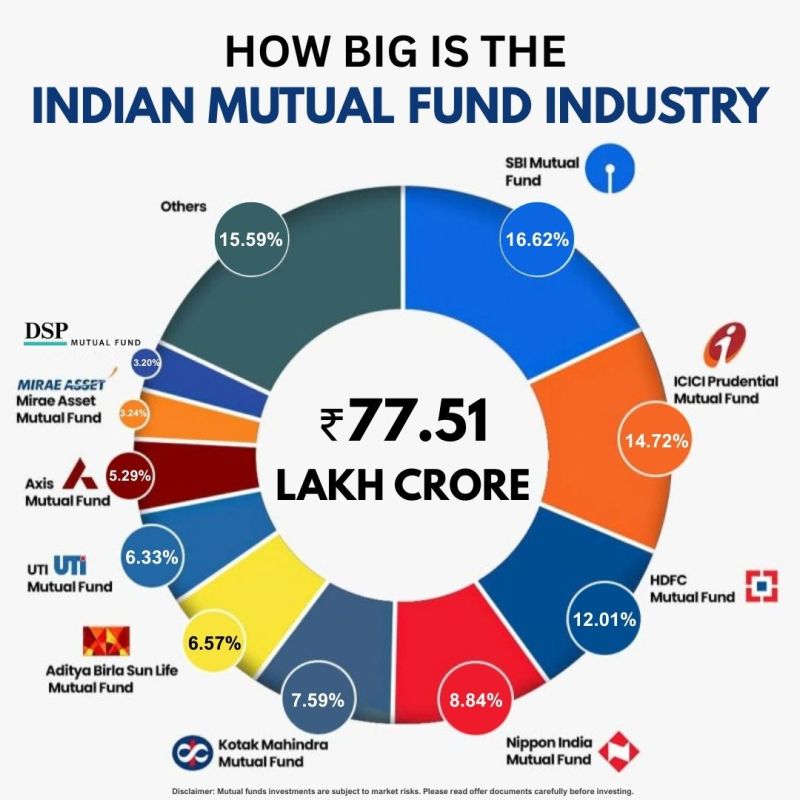
The Indian mutual fund industry has grown nearly tenfold in a decade from ₹8 lakh crore in 2014 to ₹77.51 lakh crore in Aug 2025- poised to cross ₹100 lakh crore.

💡 What’s driving this surge?
-> Increasing financial awareness among households
-> The rising popularity of Systematic Investment Plans (SIPs)
-> Easy-to-use digital platforms making investing seamless and accessible

Mutual funds are no longer confined to big cities- investors from Tier 2 and Tier 3 locations are joining in, making wealth creation more inclusive and widespread across India.

Key Industry Highlights:
-> YoY Growth: +14.0% (~₹9.49 lakh crore higher than Aug 2024)
-> MoM Growth: -0.2% (~₹0.18 lakh crore decrease from Jul 2025)
-> Top 5 AMCs (SBI, ICICI, HDFC, Nippon, Kotak) control ~56% of total industry AUM.
-> Next 5 AMCs (Aditya Birla, UTI, Axis, Mirae, DSP) control ~20% of total industry AUM.
-> Total amount collected through SIP during August 2025 was ₹ 28,265 crore ( v/s ₹ 23,547 crore in Aug 2024, 20% YoY growth)
-> Passive fund inflows + SIP growth are driving YoY momentum in mid-sized AMCs like PPFAS, WhiteOak, Motilal Oswal.

As traditional savings like gold and real estate give way to smarter, market-linked options, mutual funds are emerging as the preferred choice- offering professional management, disciplined investing, and the unmatched power of compounding.

Stay invested, stay consistent, and let the power of mutual funds work for your financial future.

India’s GDP Growth Likely to Slow to 6.3% in FY26, Says SBI Research Report

India’s GDP Growth Likely to Slow to 6.3% in FY26

India’s economic growth may fall short of the Reserve Bank of India’s (RBI) projection for FY26, according to the latest SBI Research Report. The report estimates GDP growth at 6.3% for 2025-26, slightly lower than the RBI’s forecast of 6.5%.

Q1 GDP Growth Seen at 6.8–7%

SBI Research expects first-quarter GDP growth between 6.8–7%, supported by resilient macroeconomic fundamentals. However, the pace of expansion is likely to moderate in subsequent quarters due to muted private capital expenditure (capex).

  • Q2 FY26: 6.5%

  • Q3 FY26: 6.3%

  • Q4 FY26: 6.1% (lowest for the year)

In comparison, the RBI projects Q1 growth at 6.5%, Q2 at 6.7%, Q3 at 6.6%, and Q4 at 6.3%.

Key Concerns: Weak Private Capex & US Tariffs

The report highlights that private sector investments remain subdued, based on a survey of 2,170 enterprises across agriculture, manufacturing, IT, and other sectors.

  • Capex intentions for FY26 are significantly lower than FY25.

  • US tariffs on Indian exports may further dampen investment sentiment and earnings.

  • Sectors at risk include textiles, gems & jewellery, leather, chemicals, agriculture, and auto components.

Public Capex as Growth Driver

On a positive note, SBI Research underlines that public capital expenditure remains a persistent and structural driver of growth. Government spending on infrastructure and development is expected to provide stability and cushion against global headwinds.

Banking Sector Trends: Credit Growth Slows, SME Loans Surge

India’s banking sector showed slower credit growth, slipping to 10% as of July 25, 2025, compared to 13.7% a year ago.

  • Aggregate deposits grew 10.2% YoY.

  • Credit growth weakened across most sectors except SMEs, where lending surged 21.8% YoY (up from 14.2% last year).

Outlook for FY26

India’s economy is expected to expand in the range of 6.3–6.8% in FY26, lower than the strong post-pandemic rebound of 9.2% seen in 2023-24. The SBI report concludes that while macroeconomic fundamentals remain strong, sustaining growth will require:

  • Strategic policy management

  • Boosting private investment

  • Managing risks from global trade tensions